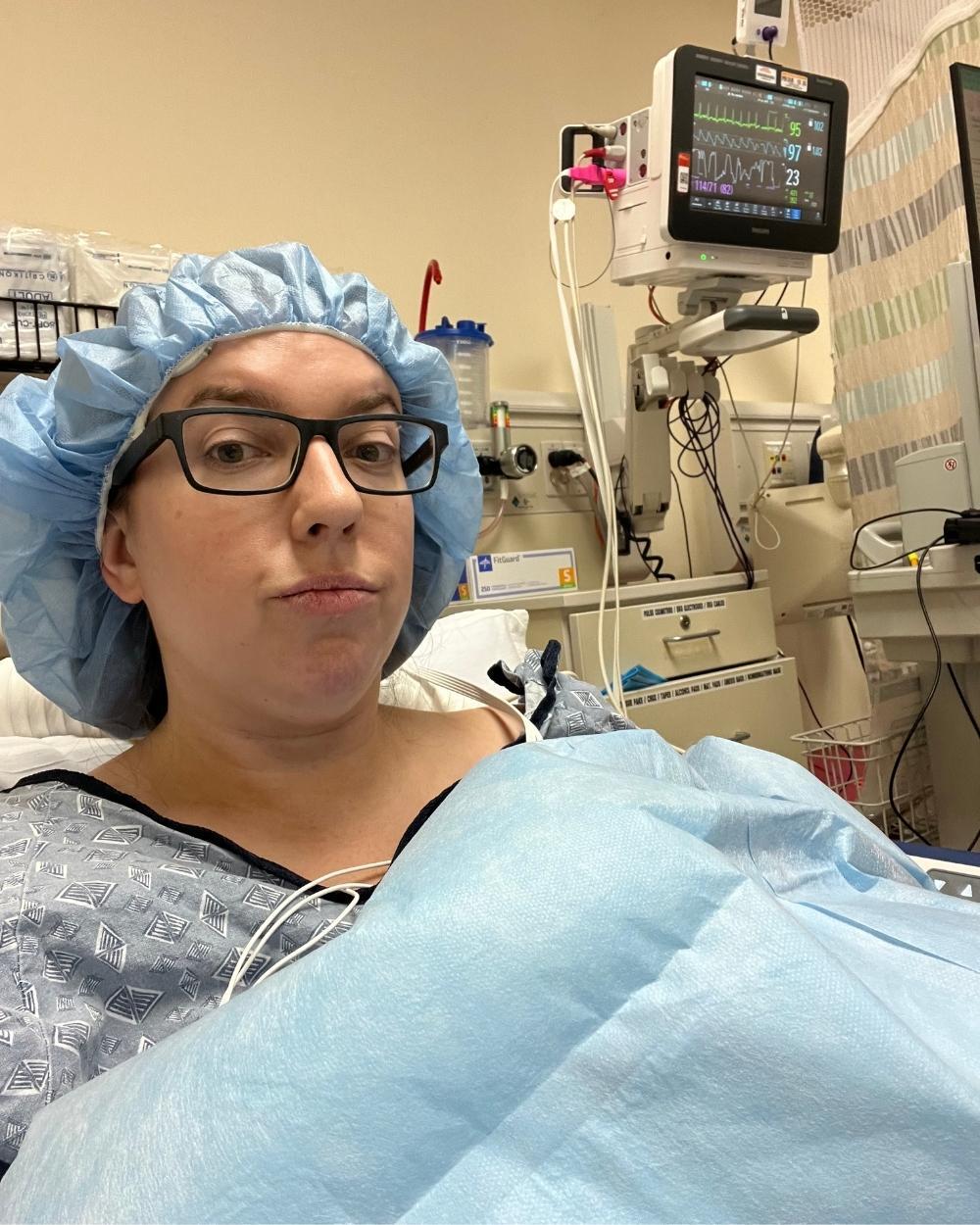
If you’ve noticed me pulling back from social media and blog content lately, it’s because I’ve been dealing with some major health issues behind the scenes. It’s taken a long time to get answers and treatment, but I’m happy to share that last month I got a full hysterectomy to treat multiple large fibroids that were causing me so much pain daily.
I had never really heard about fibroids so I wanted to share my experience in the chance it could help others on their journey. As with many womens health conditions, I don’t want them to be taboo. Fibroids were never something I heard of amongst friends and family, outside of a trying to conceive (TTC) context. Meaning childfree by choice folks, like myself, had totally tuned out of those conversations and didn’t really understand the warning signs.
Fibroids, though usually non-cancerous, are super common but they can severely impact your quality of life. I wanted to share my hysterectomy journey and how it’s helping me with a renewed sense of hope and outlook on life. Spoiler alert: I now have energy to regularly post to my blog again, so yay!
How Large Fibroids Led Me To Hysterectomy
Period Symptoms
My symptoms have been building up for years. Heavy periods throughout my 30s. Periods so heavy that I would be afraid to leave my house on day one or two. Periods so heavy that eventually evolved into irregular periods, like twice in a month, or with consistent heavy bleeding lasting longer than 7 days.
This year, these heavy periods crept into the concerning levels of blood loss, where I had a heavy period for 7 weeks straight. Prescribed medication was the only thing that could stop the bleeding. During this episode, I regularly passed blood clots larger than a strawberry and as large as the palm of my hand. I would fully saturate a super plus or ultra sized tampon and overnight maxi pad within an hour. I would regularly bleed through my pants.
As a grown adult, it was both alarming and humiliating to deal with. It brought me mentally back to my teenage years and navigating this all fo the first time. Why couldn’t I manage bleeding as a full grown adult? Going to work and night class was hard to manage because I’d have to carry so many period products with me for a single day out of the house. Especially since I had to double up everything.
To add insult to injury, these insanely heavy periods were met with intense cramping pain. Cramps that feel like they’re twisting and pulling your internal organs in different directions. Constant throbbing pelvic and abdominal pain that makes me want to lay down with a heating pad. Everyday began to feel like the worst period of my life.
Iron Deficient Anemia Symptoms
Due to this severe blood loss every month, I became iron deficient anemic. This was my diagnosis in February, with a ferritin level of 3. At the time, I had no idea fibroids would be the underlying cause. This extreme anemia had me feeling like a walking dead person. No amount of caffeine could combat the extreme fatigue and exhaustion. I was able to show up at work and perform each day, but not have energy leftover for much else. Concentration was difficult and headaches were frequent. Dealing with constant brain fog for months on end left me little motivation and bandwidth to work on my blog or other hobbies.
I could be fully rested and it would have zero affect on my energy levels. As soon as I would come home from work, I’d shower and immediately get into bed to wind down for the evening. I’m talking about being in bed at 6:30pm or 7:00pm on a weeknight. I wouldn’t even have enough energy or stamina to cook dinner some nights.
On the outside, I was beginning to look really run down. My fair skin was paler than normal. My fingernails were brittle and splitting, while my toenails were becoming detached and hanging on by a thread. The hair on my head was falling out by the handful and in clumps. My physical stamina was impacted as well. Walking up stairs left me winded and breathing heavily. The thought of washing my hair or “an everything shower” was overwhelming because of the lack of energy. Overall it just felt like my body was really depleted and systems were starting to shut down.
View this post on Instagram
Bloating Symptoms
Before I was diagnosed, I recognized a few other changes happening with my body. First, sudden new bladder pressure. I later learned this was not necessarily urinary incontinence, but the sensation of needing to urinate frequently. As in, about once every hour. Not a lot of volume would come out, either. I would later find out this was my uterus pushing on everything in my abdomen, and most closely my bladder. This was a huge inconvenience of needing to find a bathroom immediately wherever I went.
Next, was the gradual and then explosive stomach bloat. Some days my belly was soft, other days it felt hard. I could feel the mass during certain yoga and pilates positions. Moving around it became increasingly difficult. My clothes started to become tight or not fit whatsoever. I would also eat less because the extreme bloat gave me a fullness feeling. Despite eating less calories and volume, my distended stomach grew larger and larger. My lower back began to hurt. And people would openly ask if I was pregnant, which was absolutely humiliating.
Finally, the newest symptom which only really crept up in the last month or two was pressure on my bowels. Similar to the pushing on my bladder, I could feel some type of pressure on my bowels that made going uncomfortable. With weeks away from my surgery date, I just knew this was part of this entire mess and it would be resolved soon.
Diagnosis
In February, my primary care physician and I set out a plan for bloodwork every 2 months to track my iron levels after taking iron supplements. This was also the month I had my never-ending heavy period from hell. I phoned the on-call nurse several times during that episode when the amount of blood loss was alarming. They prescribed me pills to stop the bleeding, that had a long taper and were successful at ceasing the hemorrhaging.
In April, after my next bloodwork appointment that had poor ferritin results, I had a pelvic and vaginal ultrasound to see what might be going on inside. I had never had an ultrasound before so it was a totally new experience and a little awkward, but not painful. After my report came back with multiple large fibroids, I had a call with my OBGYN and we discussed medically necessary treatment options. These fibroids were wreaking havoc on my daily life and causing so much pain and discomfort. I learned that fibroids don’t go away on their own, and even with some surgical options, they can grow back and grow larger than before.
Surgery Prep
In May, I was up for an endometrial biopsy, and a surprise polyp removal. This procedure is absolutely uncomfortable and entirely unmedicated, and I never want to experience it again. After the results came back normal, it was time to get my surgery consultation. And though I knew what surgical option I wanted in my head, I still had some flexibility to explore options when it was time to speak with my surgeon.
After my surgery consult, my surgery date was scheduled and just a few final appointments remained. First was more bloodwork which revealed my ferritin had increase to 5, which is still considered very low. Then I provided a urine culture to make sure everything was ready for surgery. Meaning, I am not pregnant and I do not have a UTI which could risk complications. After that, I was finally offered an iron infusion to prepare me for surgery. I had a few phone visits to go over pre-operative care to make sure everything went smoothly.
@chelseapearl_ This is what healing looks like: hysterectomy at 37 years old #hysterectomy #hysterectomyrecovery #hysterectomyjourney #fibroids #fibroidsurgery #creatorsearchinsights
Surgery
Hysterectomy was my treatment choice and the easiest YES at this stage in my life. This is the most comprehensive treatment method for dealing with uterine fibroids because it removes them entirely and doesn’t give them an opportunity to grow again in the future by way of removing the entire uterus. This was the best option for me because (A) I don’t have time for multiple surgeries, and (B) I am childfree by choice. The only purpose of the uterus is to grow a baby and since I do not desire children, we can get rid of that entire organ for the greater concern of my overall health.
This choice was similar to my medically necessary breast reduction several years back. The surgeon explained I would never have the opportunity to breastfeed. That was of zero concern to me since I never wanted to give birth. I am very appreciative to medical professionals who respect patients’ own bodily autonomy, because I know that is not everyone’s experience.
I got a robot-assisted laparoscopic full hysterectomy, which included removal of the uterus, cervix and fallopian tubes, leaving the ovaries behind. My surgery went really smoothly and lasted about 3 hours. My uterus was over 4x the size of a normal uterus, weighing in at 1 pound 1 oz. It was 16cm in diameter, so about the size of a 4 month pregnancy. There were large fibroids inside it, and a huge 8cm fibroid behind it, adding to the bulk of tissue removed.
This surgery technique is really advanced and is a fantastic option for lesser downtime, potential for less blood loss, and faster recovery. I have only 5 incisions on my stomach, with the largest measuring around 2 inches.
@chelseapearl_ 3 days post op: swollen and bruised, but already more slim and closer to my normal size before my uterus grew with fibroids. Feeling less heavy. Over one pound of tissue was removed! #hysterectomy #hysterectomyrecovery #hysterectomyjourney #fibroids #fibroidsurgery
Recovery
Currently I’m about 2 weeks post op and I feel amazing! I’m already down 12 pounds and my stomach is so much flatter. The brain fog is gone, the cramping is gone, and I’m not bleeding 24/7 anymore. I’m certainly still swollen and have a long way to go with incision healing, so I’ll continue to document my progress on my Instagram Stories.
During this phase of recovery, I cannot be submerged in water due to my vaginal cuff stitches healing internally. That’s where they removed my cervix and closed off what used to lead to the uterus. So that means no baths or swimming. I’m also taking care in how I move, so no heavy lifting or pulling until my insides can heal up a bit more. Walking is my primary physical activity at this point, and I’ll soon graduate to gentle yoga. 8 weeks is the next big milestone for doing more normal things.
As for time off work, hysterectomy recovery is going to entirely depend on the surgical technique used. With robotic laparoscopic and no complications thus far, I took 3 weeks off work and will return to my corporate job next week.
My new reality of never needing tampons, pads, period underwear, and birth control ever again are just the icing on the cake! I cannot wait to go buy white pants and a white bikini, something I’ve never been able to do before. Something others may take for granted.
In conclusion, undergoing a hysterectomy for large fibroids was the ideal decision for me and has greatly improved my quality of life already. By choosing this comprehensive surgical option, I was able to eradicate my fibroids with zero chance of them growing back. While every person’s situation is unique, discussing your individual options and treatment plan with a healthcare provider will give you the best and most accurate information possible. Hysterectomies are actually the second most common surgery on females in the United States, second to C-sections, so you might be surprised about how common they are and how life-changing they can be!

Chelsea Pearl is a Bay Area lifestyle blogger and content creator covering California travel, Sonoma wine country, restaurants, fashion, beauty, retro gaming, cosplay, and lifestyle since 2009. She holds both the WSET Level 3 Award in Wines with distinction and Napa Valley Wine Expert certifications. She shares firsthand reviews, wine recommendations, travel guides, and pop culture content across the San Francisco Bay Area and beyond.
Leave a Reply